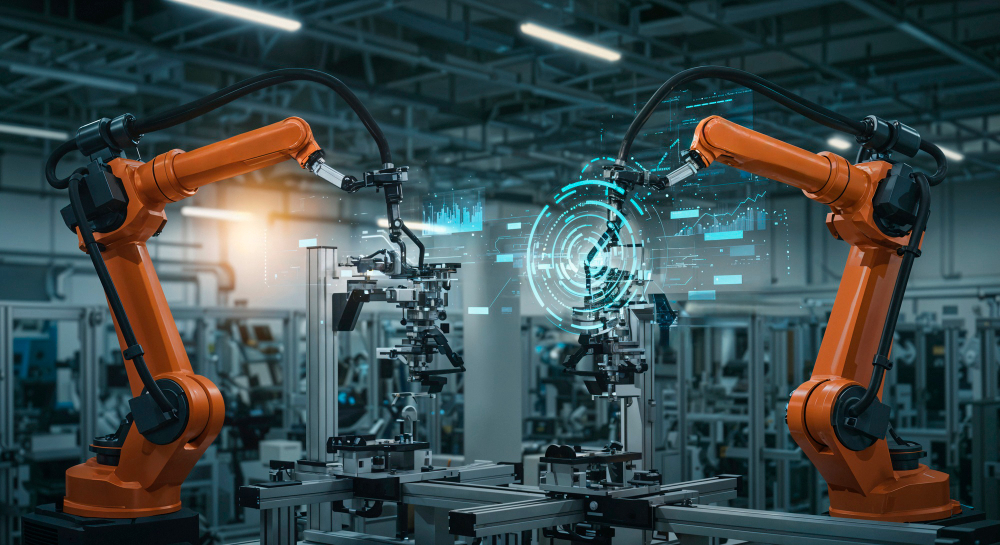
Industry 4.0 marks the beginning of a powerful transformation that reshapes how industrial companies operate. Industry 4.0 eliminates manual tracking errors across many areas—from production to quality control, from maintenance to supply chain management. Industry 4.0 places digital process management at the center, offering businesses speed, accuracy, and a strong competitive advantage.
For many years, industrial companies relied on manual processes, which caused significant time losses, data errors, and increased costs, especially in complex production environments. With digitalization, these challenges have begun to disappear, allowing companies to work with more controlled, measurable, and trackable processes. This transition is not only a technological upgrade but also a complete transformation of the manufacturing culture.
Why Has Digital Process Management Become Inevitable?
Today’s rapid production pace and rising customer expectations make it impossible for companies to remain competitive with old habits. Manual tracking is especially risky in data-intensive industrial environments:
Delays in information flow
Inconsistent records in paper-based processes
Communication gaps between departments
Errors in stock and cost calculations
Uncertainty in production planning
Digital process management minimizes these problems, offering companies transparent, fast, and measurable workflows. It also reduces employee workload and allows them to focus on more strategic tasks.
The Smart Factory Concept Enabled by Industry 4.0
Approach aims not only to digitalize factories but also to transform them into smart manufacturing centers. Machines communicate with each other, production stages are monitored in real time, and continuous improvement cycles are supported by big data analytics.
Advantages of smart factories include:
Real-time production monitoring
Predictive maintenance
Reduced downtime
Optimized energy consumption
Data-driven decision-making
This increases efficiency, reduces costs, and ensures consistent quality.
Challenges in Transitioning from Manual to Digital
As with any transformation, the digitalization journey comes with challenges. However, with proper guidance, these challenges are easily overcome.
Habit-driven work culture
Perceived complexity of digital tools
Need for employee training
Integration problems with legacy systems
Choosing the right software and providing strong training support makes the transition smooth and sustainable.
Advantages of Digital Process Management with Industry 4.0
Higher efficiency
Lower operational costs
Improved cross-department integration
More accurate reporting
Stronger competitiveness
Where Should Companies Start Their Digital Transformation?
Analyze existing processes
Identify critical areas for digitalization
Choose the right digital tools and ERP systems
Plan employee training
Set measurable KPIs
Conclusion
Competition in the industrial sector is no longer based solely on production volume—it depends on the strength of technology used. Industry 4.0 enables companies to achieve transparent, fast, efficient, and reliable processes. Manual errors fade away, while businesses gain access to healthier data.
Digital transformation is not a trend—it is the new standard for industrial production.
You can learn more about why digitalization is now essential by checking out our article Digital Transformation: Shaping the Future
Comments are closed